

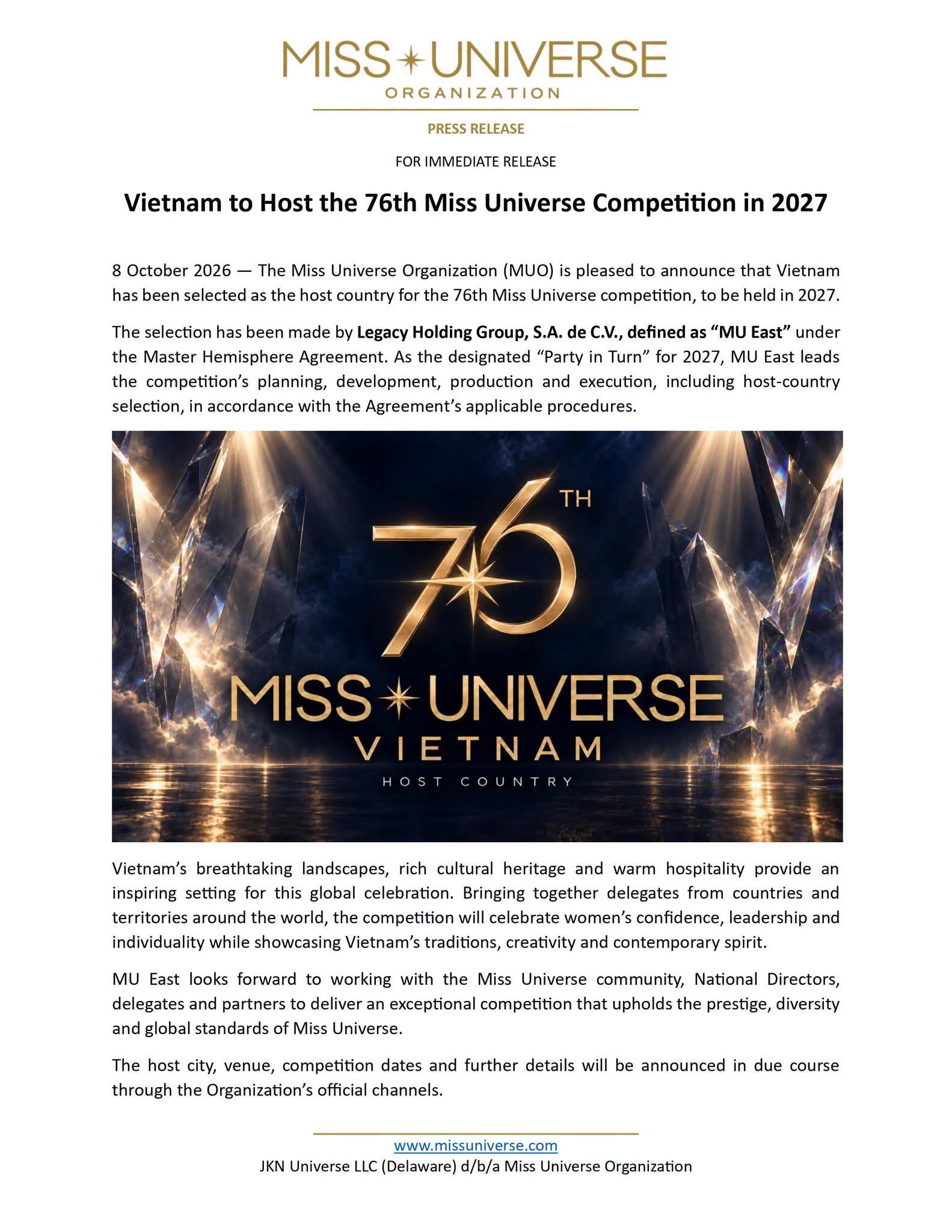
The Miss Universe Organization finds itself at the centre of a growing dispute over authority, legitimacy and the future direction of one of the world’s most recognised beauty pageants. With conflicting statements emerging over the 2027 host country and the role of an entity identified as MU East, questions are being raised about the relationship between the organisation’s Eastern and Western interests.
The Miss Universe brand has long been associated with international beauty, cultural exchange and the empowerment of women. However, two conflicting official-looking statements dated October 2026 have brought a different conversation into the spotlight: who has the authority to speak for Miss Universe, and who ultimately controls its international operations?
Vietnam Announced as Host for Miss Universe 2027
On 8 October 2026, a press release bearing the Miss Universe Organization name announced that Vietnam had been selected to host the 76th Miss Universe Competition in 2027.
According to the statement, the selection was made by Legacy Holding Group, S.A. de C.V., described as MU East, under a Master Hemisphere Agreement. The release further stated that MU East had been designated the “Party in Turn” for 2027, giving it responsibility for planning, development, production and execution of the competition, including host-country selection.
The announcement presented Vietnam as an exciting destination for the international event, highlighting its cultural heritage, scenic landscapes and hospitality.
For pageant fans, the news appeared to signal a major development for Southeast Asia, a region with a growing presence in international beauty competitions.
However, a second statement issued under the Miss Universe Organization’s name challenged the announcement almost immediately.
The Western Side Pushes Back
In a separate official statement, the Miss Universe Organization disputed the authority of parties claiming to represent the organisation through agreements involving MU East.
The document stated that the organisation did not recognise MU East, or similar designations, as an official body, division, affiliate or authorised representative of the organisation.
It also questioned the validity of the agreement being invoked by third parties, stating that the agreement allegedly lacked the required corporate approval.
Most significantly, the statement directly addressed the Vietnam announcement.
According to the document, Vietnam had not been officially designated as the host country for the 76th Miss Universe Competition in 2027. It added that the official host country would be announced at the conclusion of Miss Universe 2026, scheduled to take place in San Juan, Puerto Rico.
The statement also raised concerns about the control of the missuniverse.com domain and certain social media accounts, alleging that they were under the unauthorised control of individuals outside the organisation’s legitimate administration.
These competing claims have created confusion about which announcements should be regarded as authoritative.
It is important to note that the two supplied documents have not been independently authenticated here. Their claims should therefore be treated as statements attributed to the respective documents, rather than as independently established facts.
Is This Really a War Between the East and the West?
Although the dispute can be described as a potential East-versus-West power struggle, the documents suggest that the central issue is not necessarily geography.
At its core, the disagreement concerns corporate authority, contractual recognition, control of official communications and the right to make decisions on behalf of the Miss Universe Organization.
The reference to MU East suggests a proposed arrangement involving different hemispheres or regional responsibilities. One statement presents that arrangement as the basis for selecting Vietnam as the 2027 host, while the other rejects MU East’s status as an authorised part of the organisation.
This distinction matters.
A regional partnership, licensing agreement or contractual arrangement does not automatically establish that every party involved has the authority to make binding decisions for a global organisation. That authority depends on the relevant agreements, corporate approvals and the legal standing of the parties involved.
Until those matters are clarified, describing the situation as a confirmed split between Eastern and Western factions would go beyond the available evidence.
Nevertheless, the conflicting announcements have placed the Miss Universe brand in an uncomfortable position, with two documents presenting incompatible accounts of who has the authority to determine the competition’s future.
The Battle for the Miss Universe Brand
In the modern pageant industry, control of a brand extends far beyond the right to organise a final show.
It can involve national franchise agreements, sponsorship deals, broadcasting rights, contestant participation, host-city negotiations, international partnerships and the management of official digital platforms.
Consequently, a disagreement over who can represent Miss Universe could have implications across the entire pageant ecosystem.
1. National directors could face uncertainty
Focus Keyphrase: Miss Universe East vs West
National directors depend on clear communication from the international organisation. They need to know which authority can issue official instructions, recognise national franchises and provide binding decisions.
SEO Title: Miss Universe East vs West: The Dispute Over Vietnam and the 2027 Competition
If competing parties issue contradictory announcements, national directors may be left uncertain about which communications to follow.
For countries preparing their representatives for Miss Universe 2027, clarity regarding the official competition arrangements would be particularly important.
2. Contestants could become caught in the middle
The women competing for national titles invest considerable time, money and effort in preparing for the international stage.
They deserve certainty about the competition they are entering, the legitimacy of the franchise through which they qualify and the arrangements governing their participation.
Any prolonged disagreement over international authority could create unnecessary uncertainty for contestants, national organisations and their supporters.
3. Sponsors and host countries need certainty
Hosting an international event of Miss Universe’s scale requires substantial planning and cooperation between organisers, sponsors and local authorities.
A host-country announcement can influence negotiations, tourism planning, marketing campaigns and commercial commitments.
If the parties responsible for making that announcement disagree over its legitimacy, potential partners may seek clarification before committing resources.
Vietnam’s reported selection therefore remains a key issue in the dispute, but the second statement makes clear that the organisation’s position, as presented in that document, is that the host country has not yet been officially determined.
4. Fans need a reliable source of information
Miss Universe has an international audience that follows announcements through websites, social media pages, national directors and pageant news outlets.
When different channels publish contradictory information, fans can struggle to distinguish confirmed developments from disputed claims.
The disagreement over the missuniverse.com domain and other social media accounts makes this issue particularly significant.
The organisation’s identity is not merely a logo or a website. It also depends on the public’s ability to establish whether a communication genuinely represents the organisation.
Who Has the Final Say?
At this stage, the most important question is not which side is geographically Eastern or Western.
It is which party can demonstrate the legal and corporate authority to make decisions on behalf of the Miss Universe Organization.
Resolving the dispute would likely require clarity on several matters:
- The Master Hemisphere Agreement: What does the agreement actually authorise, and which parties are bound by it?
- Corporate approval: Were the relevant decisions approved by the appropriate corporate authorities?
- The status of MU East: Is it an authorised contractual partner, a regional operating structure or a designation disputed by the organisation?
- Official communications: Which websites, social media accounts and representatives are currently authorised to issue announcements?
- The 2027 host country: Has Vietnam been formally selected through a process recognised by the organisation’s legitimate decision-makers?
The answers would help establish whether the Vietnam announcement represents an authorised decision, a disputed contractual interpretation or an announcement that the organisation does not recognise.
Without the underlying agreements and independently verified corporate records, it would be premature to declare either party the winner of this dispute.
What Does This Mean for Miss Universe 2027?
For now, the two statements offer conflicting positions on the future host country.
The first announces Vietnam as the destination for the 76th Miss Universe Competition in 2027. The second explicitly rejects that announcement and says the host country will be revealed after the Miss Universe 2026 final in Puerto Rico.
Until the conflict is resolved through a clear, verifiable announcement from the organisation’s legitimately authorised representatives, the Vietnam selection should be described as disputed rather than definitively confirmed.
Pageant journalists, national directors and fans should be cautious about treating either document as conclusive proof of the underlying legal position without further verification.
The answer will depend on verifiable corporate decisions, the relevant agreements and further official clarification. Until then, the pageant world will be watching closely to see how the organisation addresses one of the most consequential questions facing its international operations.
The most reliable next step would be to establish which corporate entity currently has the recognised authority to make official Miss Universe announcements and to review any subsequent statements or legal developments.
The Bigger Picture: Can Miss Universe Maintain Its Global Unity?
Miss Universe is more than an annual competition. It is an international network connecting national pageants, contestants, franchise holders, commercial partners and millions of followers.
Suggested WordPress SEO Details
Its global identity depends on a degree of institutional stability. National organisations need dependable leadership, contestants need transparent competition rules, and commercial partners need confidence that agreements and announcements will be honoured.
A prolonged dispute over authority could threaten that confidence, regardless of whether the disagreement is ultimately resolved through negotiation, corporate action or legal proceedings.
At the same time, the available documents do not establish that the organisation has formally divided into separate Eastern and Western Miss Universe competitions. They establish that conflicting claims have been made about authority and the proposed 2027 host country.
That distinction is essential when assessing what is happening.
Conclusion: A Dispute That Could Shape Miss Universe’s Next Chapter
The competing statements dated 8 October 2026 have raised serious questions about who speaks for Miss Universe, what authority MU East possesses and whether Vietnam will host the 2027 competition.
One document presents Vietnam’s selection as an official decision made under a regional agreement. The other disputes the authority behind that announcement and maintains that the host country has not yet been designated.
For now, the situation is best understood as a dispute over governance and corporate authority rather than a confirmed war between the East and the West.
The biggest question remains: Who has the legitimate authority to determine the future of Miss Universe?


What do you feel about this post?

Like

Love

Happy

Haha

Sad
